Meet the Razor-Backed Musk
If you’ve ever wandered through the aisles of a specialty reptile store or scanned the murky waters of a southern swamp, you might have caught a glimpse of a turtle that seems almost… secretive. That, my friend, is the Razor-Backed Musk. Not your everyday pond scuttler, not your flashy red-eared slider—no, this little aquatic marvel carries an air of mystery, a quiet confidence, and a few quirks that make it unforgettable. I’ve been around turtles long enough to know that some species just… stick with you. And the Razor-Backed Musk? It will leave a mark on your memory before it ever leaves your tank.
| TORTOISE PROFILE | |
|---|---|
| Tortoise | Razor-Backed Musk |
| Binomial Name | Stigmochelys pardalis |
| SCIENTIFIC CLASSIFICATION | |
| Kingdom | Animalia |
| Phylum | Chordata |
| Class | Reptilia |
| Order | Testudines |
| Family | Testudinidae |
| Subfamily | N/A |
| Genus | Stigmochelys |
| Species | pardalis |
| Varieties | N/A |
| ENVIRONMENT | |
| Living Environment | Terrestrial, savannas, scrublands, and grasslands |
| Found in | Eastern and Southern Africa: Kenya, Tanzania, Zimbabwe, South Africa |
| Space Requirement | Large outdoor enclosures recommended; minimum 6×6 ft per adult |
| Average Lifespan | 40–50 years |
| Exceptional Cases | Up to 70 years in optimal captivity conditions |
| Length | 12–18 inches (30–45 cm) |
| Weight | 15–30 pounds (7–14 kg) |
| Temperature | 75–90 °F (24–32 °C) ambient, 95 °F (35 °C) basking |
| pH | Neutral to slightly acidic soil (6.5–7.0) |
| PERSONALITY | |
| Temperament | Docile, slow-moving, generally calm |
| Social Behaviour | Mostly solitary; mild interactions with other tortoises |
| Diet | Herbivore |
| Food Type | Grasses, leafy greens, vegetables, occasional fruits |
| KEY FACTORS AFFECTING LIFESPAN | |
| Enclosure / Tank size | Large, secure enclosure essential; overcrowding causes stress and stunted growth |
| Habitat / Water quality | Requires dry substrate with shaded areas; water dish for soaking; avoid standing water |
| Diet | Balanced herbivorous diet with calcium supplementation; poor diet leads to shell deformities |
| Companions | Compatible with other non-aggressive tortoises if space is sufficient |
| Temperature / Environment stability | Sensitive to cold and damp conditions; needs stable warm and dry environment |
| CARE DIFFICULTY | |
| Difficulty Level | Moderate |
| Messiness | Low; primarily leaves and droppings in enclosure |
| Additional Requirements | – Spacious outdoor or indoor pen – UVB lighting if indoors – Shaded areas and water dish for soaking – Calcium and vitamin supplementation |
| Special Notes | Requires warm, dry climate; vulnerable to respiratory infections if enclosure is damp or cold |
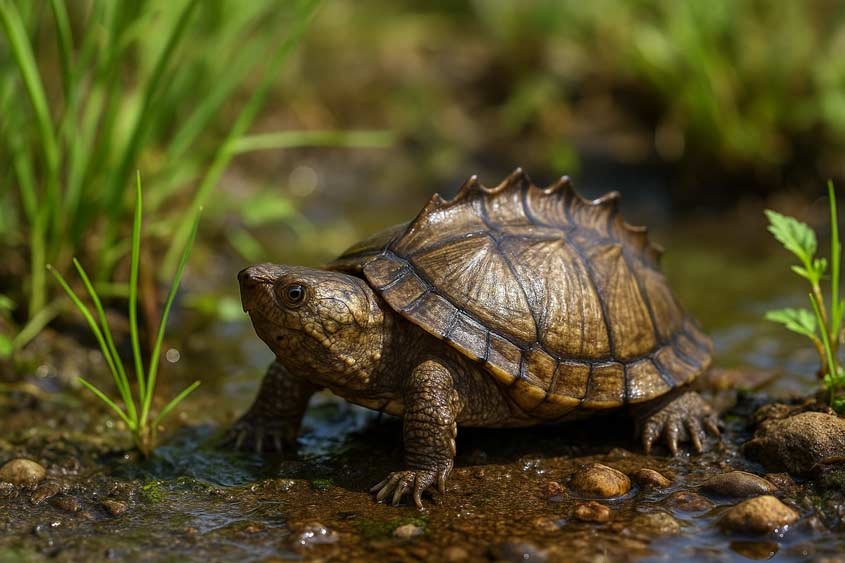
First, let’s talk appearance. You’d think the name alone—“Razor-Backed”—would set your expectations sky-high, and it does. Its carapace is narrow, almost spine-like along the center, giving it a slightly armored, primitive look. The shell isn’t flat and smooth like the ones you see on the common sliders; it’s a little ridged, a little jagged, like someone took a delicate sculpture of a turtle and added a hint of danger. And then there’s the color palette: muted browns, subtle greens, a dash of marbled black. It’s not trying to be flashy. No neon stripes or bright orange flashes here. It’s understated, like the quiet, contemplative type at a party—you know, the one who notices everything but doesn’t announce it.
Table of Contents
Behavior-wise, the Razor-Backed Musk is fascinating. They’re shy but curious. At first, you might think they’re just hiding under a log, refusing to interact. But watch closely, and you’ll see them peek out, almost cautiously, checking the environment like a tiny sentinel. Unlike the more active aquatic species, these turtles move deliberately. Every glide through the water is calculated, almost meditative. I remember the first time I introduced one to a tank with a few more outgoing turtles—it was hilarious. The bold ones would zoom past like they owned the place, and the Razor-Backed Musk would slowly emerge from its hiding spot, watching, waiting, giving the occasional blink as if to say, “I see you. I know what you’re doing.” There’s a kind of personality in that. You can’t rush it. You have to earn its trust.
Another thing that sets this species apart is that subtle musk they can emit when threatened. It’s not something you notice immediately, but if a little hand reaches in too aggressively or if a new tank mate is being a tad too pushy, the Musk will let off a faint, earthy scent—almost like a whisper of warning. And here’s the thing: it’s not obnoxious, it’s not offensive, but it’s a clever survival tactic. In the wild, it probably makes predators think twice, and in captivity, it’s a gentle reminder that this turtle has boundaries, and boundaries matter. Honestly, it’s part of the charm. Watching a turtle assert itself in such a subtle, almost polite way is… well, it’s strangely endearing.
Now, I should say: this isn’t a turtle for someone who wants instant gratification or flashy antics. If you’re expecting a fountain of activity or a pet that will happily cuddle on your hand like a puppy, you’ll be disappointed. But if you’re patient, if you enjoy observing the small details, noticing the slow choreography of fins and claws and delicate nudges through the water, you’ll find the Razor-Backed Musk infinitely rewarding. It’s a bit like watching a slow-burning movie—you don’t get the explosion at the start, but by the end, you’re captivated.
One thing I often tell newcomers: don’t underestimate them because of their size. Razor-Backed Musks are modestly sized, but they carry a presence. They’re not going to dominate a tank in the way some larger species might, but they command attention with quiet dignity. And the first time you see one stretch out fully in the sunniest corner of the tank, basking like a miniature emperor, it’s hard not to feel a little awe. They’ve got a rhythm to their life, and when you slow down enough to notice, it’s mesmerizing.
It’s also worth mentioning that these turtles are deceptively hardy. Sure, they need clean water, proper filtration, a suitable diet, and all the usual care any aquatic turtle requires—but once they’re settled, they tend to thrive. They’re survivors, shaped by rivers, swamps, and marshlands that are often unpredictable and murky. In that sense, they carry the whispers of their wild habitat with them: a little resilience, a little cunning, and a lot of patience.
The Razor-Backed Musk is more than just a pet—it’s a companion for those willing to appreciate subtlety. Watching one glide silently beneath floating plants, or noting the way it cautiously inspects a new ornament in its tank, you start to see the intelligence and character in these small, armored bodies. And yes, I know that sounds a bit like anthropomorphizing, but anyone who has spent time with one knows it’s hard not to feel a little human connection. They’re quietly opinionated, a bit old-fashioned, and endlessly fascinating.
So, if you’ve been hunting for a turtle that rewards observation over interaction, patience over instant gratification, and subtle beauty over bold colors, the Razor-Backed Musk might just be your perfect match. And trust me, once you get to know one, you’ll start looking at turtles a little differently. You’ll start noticing the little quirks, the tiny gestures, and the hidden wonders tucked under those armored shells.
By the time you move on to learning about their habitat, diet, and tank setup, you’ll realize something crucial: keeping a Razor-Backed Musk isn’t just about housing a turtle. It’s about joining a small, secretive world and learning to see the extraordinary in the quiet and the small. And that, in my opinion, is what makes them so unforgettable.
Natural Habitat: Life in the Waters of the South
When you picture the Razor-Backed Musk in its natural home, don’t imagine a pristine aquarium or a manicured garden pond. No, this is a turtle forged by murky rivers, shaded swamps, and slow-moving backwaters where every stick, leaf, and swirl of sediment tells a story. Its wild habitat stretches across the southeastern United States, though some populations can be spotted in neighboring regions where waterways remain quiet, soft-edged, and rich with aquatic life. These aren’t the bustling, fast-flowing rivers that make your toes tingle—they’re the lazy, secretive waters where the Razor-Backed Musk has evolved to be both predator and stealthy observer.
Where They’re Found in the Wild
Razor-Backed Musks favor rivers and wetlands that offer plenty of cover. Think fallen logs, thick mats of floating vegetation, and muddy banks where they can hide from hawks, raccoons, or even the occasional human curiosity seeker. It’s fascinating—these turtles don’t need flashy surroundings. In fact, their muted shell colors mirror the murky greens and browns of their environment, an exquisite camouflage that makes them almost invisible if you’re not paying attention. I once spent an afternoon watching a small creek, scanning the shallows with a net for curiosity’s sake, and it took me a good ten minutes to spot a tiny Razor-Backed Musk tucked under a fallen branch. One flick of its claw or a subtle head movement, and it would’ve vanished completely. That’s nature’s magic right there.
These habitats aren’t just about hiding. The slow currents and shallow pools are rich hunting grounds. Aquatic insects, snails, small fish, and even decaying plant matter form the bulk of their diet. The complexity of their environment—twisting roots, submerged logs, and pockets of still water—allows them to hunt, rest, and navigate without ever straying too far from safety.
Adapting to Murky Rivers and Swamps
Adaptability is key for a turtle that thrives in such unpredictable conditions. The Razor-Backed Musk’s narrow, ridged shell isn’t just for looks—it allows it to slip between submerged branches and through thick mats of vegetation with surprising grace. Its flattened profile helps it hug the riverbed when a predator passes above, and its subtle coloration ensures it blends seamlessly with the silt and shadows. Every physical trait screams “survival specialist.”
Water temperature and quality vary wildly across their range, and these turtles are surprisingly resilient. They’ve evolved to tolerate fluctuations that might stress other species. Murky water? No problem. Low oxygen levels? They’ve got strategies for that too. This isn’t a creature that needs constant attention in the wild—it thrives by reading its environment, knowing when to hide, when to forage, and when to bask. It’s a rhythm that has guided generations for centuries.
Environmental Factors Shaping Their Behavior
- Vegetation Density: Thick aquatic plants provide hiding spots and hunting grounds. Razor-Backed Musks rely on this cover to feel secure.
- Water Depth: Prefer shallow areas with calm currents but can navigate deeper pools when necessary.
- Substrate: Mud, sand, and leaf litter allow for natural foraging behaviors, digging, and resting.
- Temperature Variability: Adapted to seasonal changes, from warm summers to mild, cool winters in southern waterways.
- Predation Pressure: The presence of predators affects their boldness—turtles in predator-heavy areas tend to be more secretive and cautious.
The beauty of studying their habitat is seeing how behavior and environment are so intertwined. In captivity, we try to replicate this as best as possible, but the wild gives you layers of nuance you can’t fully capture: the gentle tug of current, the soft rustle of leaves overhead, the way sunlight dances through water and creates fleeting patterns on a muddy riverbed. Every micro-detail informs how a Razor-Backed Musk moves, eats, and rests.
I often tell new turtle enthusiasts that watching them in a simulated natural habitat is like peeking through a window into a secret world. You start noticing subtle signals: a slight pause before a turtle crosses an open patch of water, a deliberate glide under a floating plant, or the way it shifts its head to smell the water before investigating. These aren’t random actions—they’re behaviors honed over millennia to survive the swamps, rivers, and marshes of the South.
And yes, the environment shapes personality too. Turtles in more exposed waterways tend to be bolder and a little more exploratory. Those in dense, predator-heavy regions are cautious, deliberate, and slow to trust. Even among the same species, habitat nuances leave distinct marks on temperament. That’s one of the things that makes the Razor-Backed Musk so endlessly fascinating—you start realizing that every turtle carries a story, a reflection of the water it calls home.
By the time you’re ready to move on to care in captivity, understanding this habitat is crucial. It’s not just about water and food—it’s about replicating a rhythm, a set of conditions that encourage the turtle to feel safe, thrive, and show off its little quirks. They need the right amount of hiding spots, shallow and deeper water zones, and temperature variation to mirror the swamps they evolved in. Miss one element, and the personality you waited so long to see might stay hidden, tucked under a log, quietly observing from the shadows.
In short, the Razor-Backed Musk isn’t just a turtle in a river—it’s a product of its environment, shaped by currents, shadows, and the slow pulse of southern waterways. Appreciating its habitat isn’t merely academic—it’s essential for anyone hoping to keep one happy, healthy, and thriving in captivity. And, honestly, it’s a delight to learn about. Something is humbling about observing a creature so perfectly in tune with its environment, a living reminder that nature often designs beauty in subtlety, patience, and quiet resilience.
Care in Captivity: Creating a Healthy Home
Caring for a Razor-Backed Musk isn’t rocket science, but it’s also not the kind of pet you can just toss in a bowl with a couple of rocks and call it a day. These turtles have exacting—but not impossible—needs, and meeting them can be deeply rewarding. Honestly, it’s a little like setting up a tiny, self-contained swamp: you want it functional, safe, and just a touch aesthetically pleasing, but most importantly, it has to feel “right” to your turtle.
Tank Size and Setup Essentials
First things first: space matters. These aren’t giant sliders, but a cramped tank will stress them, and stress is the silent enemy of health. A general rule of thumb? Aim for at least 40–50 gallons for one adult, with additional space for every extra turtle. The Razor-Backed Musk likes to swim, explore, and hide, and a tank that’s too small will make it grumpy—or worse, lethargic.
When setting up the tank, consider zones. Create a swimming area, a shallow resting area, and a basking spot. I like to think of it as their little kingdom: the turtle should be able to glide freely, retreat under a floating log, and climb onto a smooth rock or platform to sun itself. Natural or artificial logs, driftwood, and flat rocks work wonders. And yes, hiding spots are non-negotiable. A Razor-Backed Musk is shy by nature, and providing places to duck under or squeeze behind reduces stress and encourages natural behavior.
Lighting is another key. A UVB light is essential for calcium absorption and shell health, and a basking lamp should offer a temperature gradient of roughly 85–90°F on the warm side, tapering to cooler zones around 75°F. Water temperature is also important: aim for 75–80°F, adjusting slightly depending on the turtle’s activity and diet. Trust me, these little reptiles are temperature-sensitive enough that you’ll notice changes in behavior if it’s off by a few degrees.
Water Quality and Filtration
Now, let’s talk water. Razor-Backed Musks are aquatic, so clean water isn’t just a luxury—it’s survival. A high-quality filter is a must, ideally one rated for at least double the tank’s volume. Why double? Because turtles are messy eaters. Even with careful feeding, bits of shrimp, insects, or pellets will float around and quickly foul the water. Think of the filter as both a housekeeping system and a life-support mechanism: without it, you’ll be battling cloudy water, algae blooms, and, worst of all, health problems for your turtle.
Regular water changes are critical too. I aim for 25–30% weekly, and I use a siphon to remove detritus from the substrate. Some enthusiasts swear by sand, others by fine gravel, and some prefer bare-bottom tanks. My advice? Pick what works for you, but always combine it with diligent water changes and a reliable filter. Razor-Backed Musks are surprisingly hardy, but poor water quality can undo weeks of good care in a heartbeat.
Feeding the Razor-Backed Musk Properly
Diet is where things get fun. These turtles are omnivorous, and while they love meaty treats, they also need plant matter for balance. In the wild, they feast on snails, small fish, aquatic insects, and occasionally bits of vegetation. In captivity, a mix of high-quality turtle pellets, occasional live or frozen prey (like bloodworms, shrimp, or small feeder fish), and fresh greens like dandelion or romaine works beautifully.
A few feeding tips I’ve learned from experience:
- Feed in the water: Razor-Backed Musks prefer eating while submerged, so drop food into shallow areas where they can reach it easily.
- Avoid overfeeding: These turtles are small but can pack on weight quickly, which stresses their shells and organs.
- Variety is key: A rotating diet keeps them engaged and ensures they get all the nutrients they need.
Must-Have Equipment and Diet Highlights
- Tank: Minimum 40–50 gallons per adult; add more space for extra turtles.
- Basking Platform: Flat rocks or driftwood for thermoregulation.
- UVB Light: Essential for shell and bone health.
- Basking Lamp: Creates a warm zone around 85–90°F.
- Filter: Rated for at least double the tank’s volume; clean water is non-negotiable.
- Water Temperature: 75–80°F, with occasional adjustments.
- Diet: High-quality pellets, live/frozen prey, fresh leafy greens.
- Hiding Spots: Logs, caves, or floating plants to reduce stress.
One little tip that many beginners miss: Razor-Backed Musks are curious, and they like to explore decorations, rocks, and floating plants. But make sure any décor is stable and smooth. I’ve seen turtles get wedged in tiny gaps or scratch their shells on rough surfaces—it’s avoidable with careful planning. Think of the tank as a miniature wilderness: it should challenge them a bit, but it shouldn’t be a hazard.
Lastly, pay attention to their behavior. If a turtle isn’t swimming much, hiding constantly, or refusing food, it’s usually a sign that the tank setup or water conditions aren’t ideal. These little signals are subtle but critical—they’re the turtle’s way of telling you, “Hey, something’s off.” And once you notice and adjust, you’ll often see an almost immediate change: brighter eyes, more confident swimming, and even those tiny, quirky head tilts that make them so endearing.
Caring for a Razor-Backed Musk is about creating an environment where it can express natural behaviors, feel secure, and thrive. It’s not just about the right water temperature or pellets—it’s about respect, observation, and a touch of creativity. Think of it like designing a miniature ecosystem, one that honors the turtle’s wild roots while keeping it healthy and happy in captivity. And trust me, when you get it right, seeing a Razor-Backed Musk glide gracefully through its tank, bask under the UVB light, and explore its surroundings is endlessly rewarding.
Behavior and Personality: What Owners Should Expect
If there’s one thing I’ve learned over the years, it’s that Razor-Backed Musks have personalities that surprise even seasoned turtle keepers. Don’t expect a bold, attention-seeking show-off—these turtles are subtle, mysterious, and, honestly, a little dramatic in their own quiet way. Observing their behavior feels a bit like eavesdropping on a secret conversation; every movement, glance, and twitch tells a story. And if you pay attention, you’ll start to see patterns, preferences, and quirks that make each individual unique.
Shy but Spunky—Their Temperament Explained
At first glance, they can seem timid. The Razor-Backed Musk isn’t going to swim up immediately for a hand-fed treat or pose proudly on a rock. Nope. They prefer to assess the situation, often retreating into hiding at the slightest disturbance. But don’t mistake shyness for passivity. Once they’re comfortable, you’ll notice small bursts of spunk: a daring swim across open water, a head tilt as if they’re studying you, or a sudden, determined dash after a floating treat. It’s like they’re saying, “I may be quiet, but I’ve got opinions.”
Many owners are surprised to learn that these turtles can recognize their caregivers. Over time, they start to associate the sight of a familiar hand with food or a safe environment. It’s subtle, of course—a little nudge, a flick of the eye—but those tiny gestures can be incredibly rewarding to witness. You don’t get the overt affection of a dog or cat, but you get something quieter, arguably more fascinating: trust earned, not demanded.
Interactions with Other Turtles and Fish
Razor-Backed Musks are mostly peaceful, but they have their boundaries. Introduce a new tank mate, and you’ll see some interesting dynamics. They often tolerate other turtles, especially in spacious tanks, but they’ll assert themselves subtly if they feel crowded. A slight hiss, a musk release, or a strategic retreat sends a clear message: “This space is mine, respect it.”
When kept with fish, they tend to be ambush predators—but in a measured, calculated way. Unlike more aggressive turtle species, they won’t chase constantly; instead, they wait, observe, and strike only when the timing is right. Watching a Razor-Backed Musk snap up a small feeder fish is almost like witnessing a tiny prehistoric hunting ritual. And yes, it’s a little brutal—but it’s nature, and it’s fascinating.
Social cues go beyond feeding. They have distinctive head movements, subtle glances, and body postures that communicate mood. A relaxed turtle will swim lazily, limbs extended, eyes half-closed. One that’s wary might tuck its head, flatten its body, and move in short, deliberate bursts. Over time, you start reading these cues like a language. And here’s a fun part: every turtle develops its own “personality vocabulary.” Some are explorers, some are homebodies, and some are a mix of both.
Quirks, Habits, and Little Surprises
- Nighttime Activity: Razor-Backed Musks can be surprisingly active after lights out. Expect some midnight swims if your tank lights are off.
- Head Bobs and Tilts: Often a sign of curiosity or mild irritation; pay attention to the context.
- Slow-and-Steady Approach: Unlike high-energy turtles, they take their time with everything—feeding, exploring, even basking.
- Musk Release: A gentle, earthy scent when threatened—subtle but unmistakable.
- Hiding Preferences: Some love floating plants; others prefer logs or rock crevices—observe and adjust tank décor accordingly.
One of my favorite observations involves feeding time. I once had a tank with three other turtles that zoomed at every pellet like tiny missiles. Meanwhile, my Razor-Backed Musk floated calmly at the back, watching, calculating, and then making a single, precise move to grab a morsel. No panic, no rush—just efficiency and style. It’s moments like that which remind you that patience really is a virtue with this species.
Another interesting behavioral trait is basking personality. Some love the sunniest spots, stretching luxuriously as if soaking in every ray. Others prefer the shaded edge of the platform, half in water, half out, eyes squinting, clearly savoring the ambient warmth. The differences between individuals are remarkable and reinforce the idea that these turtles aren’t clones—they’re tiny personalities shaped by experience, environment, and instinct.
And yes, I can’t resist mentioning their quirky fascination with floating objects. A small plastic ring, a leaf, or even an air bubble can captivate them for minutes at a time. It’s not play in the human sense, but it’s engagement, and it’s endlessly entertaining to watch. Some days, I’ll just sit by the tank, coffee in hand, and observe the little dramas, the tiny explorations, and the subtle competitions over basking spots. It’s almost meditative.
Understanding behavior in Razor-Backed Musks isn’t just about observation—it’s also about interaction. Knowing when to offer food, when to clean the tank, or when to step back and let them explore is key. Respect their rhythms, honor their space, and you’ll find that these turtles reward patience with moments of wonder, small but profoundly satisfying.
In short, the Razor-Backed Musk isn’t flashy, loud, or overtly affectionate. But it has personality, nuance, and intelligence, and the more you engage with it, the more layers you discover. They’re a subtle, thoughtful companion that teaches observation, patience, and appreciation for quiet beauty. And really, isn’t that what makes keeping turtles so rewarding?
Fascinating Traits: The Hidden Wonders Revealed
When people first hear “Razor-Backed Musk,” they often think, “Okay, it’s a turtle…what’s so special?” But once you start paying attention, you realize that this species is packed with hidden wonders—tiny marvels of evolution that make it unlike any other turtle in your tank or in the wild. From its unusual shell to its clever defense mechanisms, every trait tells a story of adaptation, survival, and subtle genius.
Their Unique Shell Shape and Function
Let’s start with the obvious: the razor-like ridge along their back. It’s not just for show. The elevated, narrow spine of the carapace allows them to slip through dense vegetation and tight crevices in their swampy habitats. Unlike smoother turtles that can get snagged or stuck, the Razor-Backed Musk glides through narrow spaces like a seasoned ninja. And there’s more: the shell’s jagged texture can make predators think twice. From a distance, it breaks up the outline of the turtle’s body, camouflaging it among sticks, leaves, and ripples. It’s beauty serving survival—a design that’s elegant and practical all at once.
You’ll also notice that the plastron (the belly) is softer and more flexible than some other turtles. This allows them to wedge themselves into tight hiding spots, curling just enough to disappear under a log or into a shallow nook. And if you watch carefully, you’ll see them tuck and twist almost like dancers performing a carefully choreographed move, blending perfectly with their surroundings. It’s a subtle, graceful defense strategy that’s easy to miss if you’re not paying attention.
Defensive Musk and Its Survival Role
Ah, the musk—the trait that gives the species its name. It’s understated, almost polite in how it announces itself, but it’s a brilliant survival tool. When threatened, the turtle releases a faint, earthy scent from glands near its hindquarters. In the wild, this can deter predators, and in captivity, it serves as a gentle warning to any overzealous hand or curious tank mate.
What’s fascinating is the way this musk interacts with their behavior. The turtle rarely uses it without reason. It’s a calculated defense, a little like a seasoned negotiator choosing words carefully. And as a keeper, you learn to read those subtle cues: the tail flick, the slight hiss, the tiny retracting movement before the scent appears. It’s a sensory puzzle that’s endlessly fascinating to observe and adds depth to their personality.
Longevity and What Makes Them Special Pets
Razor-Backed Musks are long-lived, often exceeding 30 years in well-maintained captivity. That’s a serious commitment, but it also means you get to watch their personalities develop and evolve over decades. They remember routines, respond to familiar caregivers, and even show changes in behavior with seasonal shifts. It’s like having a tiny, armored friend who grows wiser over the years, teaching you patience, observation, and respect for subtlety.
Another remarkable trait is their adaptability. They thrive in varied water conditions, tolerate shifts in temperature, and adjust to different tank mates. While they are shy, they are far from fragile. I’ve had my share of beginner mistakes—small overfeeding errors, slightly low water temperatures, minor tank disruptions—and yet the Razor-Backed Musk often bounced back. It’s resilience disguised as quiet composure. You start to appreciate just how tough and clever these turtles really are.
Lesser-Known Facts That Make Them Stand Out
- Night Vision: Razor-Backed Musks are adept at foraging in low-light conditions, reflecting their crepuscular habits.
- Subtle Communication: Head bobbing, slight body movements, and blinking convey mood or intention.
- Sensory Whiskers: Tiny sensory projections near the mouth help detect food or changes in water currents.
- Swimming Efficiency: Despite a seemingly cumbersome shell, they are graceful swimmers with remarkable maneuverability.
- Minimal Aggression: Unlike some turtle species, they rarely fight, preferring to retreat or assert subtly.
One of my favorite discoveries about these turtles is just how intelligent they can seem. Some individuals learn routines quickly: anticipating feeding time, exploring newly introduced decorations, or even responding to subtle environmental cues like the position of the sun or the movement of shadows across the tank. Watching a Razor-Backed Musk navigate its little world is a bit like observing a seasoned detective: cautious, deliberate, and always calculating.
And here’s a fun tidbit: some keepers report that these turtles have individual preferences for basking spots, favorite hiding places, and even certain foods over others. One of my turtles, for instance, has a particular floating log it insists on resting on, no matter how many other basking spots are available. Others might favor a shaded corner under plants. It’s these idiosyncrasies that make them endlessly engaging—no two turtles behave exactly alike, and each day brings a new little observation that delights or surprises.
Finally, it’s impossible to discuss the Razor-Backed Musk without mentioning their role as a miniature ecosystem participant. In the wild, they influence insect populations, contribute to nutrient cycling, and interact with other species in subtle but important ways. In captivity, you get a tiny glimpse of this ecological impact: their movements aerate substrates, their feeding habits help control snail populations, and their very presence adds life to the tank. It’s a gentle reminder that even a small, secretive turtle can make a big difference in its world.
In short, the Razor-Backed Musk is a masterclass in subtlety, resilience, and intelligence. Its unique shell, defensive musk, long lifespan, and surprising quirks combine to make it one of the most fascinating turtles a keeper can observe. If you take the time to notice the little things—how it moves, reacts, or explores—you’ll realize that every aspect of this turtle is a hidden wonder waiting to be appreciated. And honestly, once you’ve spent a few months with one, it’s hard to imagine any other turtle holding your attention quite the same way.
Living with a Razor-Backed Musk Turtle
By now, you’ve probably realized that the Razor-Backed Musk isn’t just another aquarium addition. It’s a companion, a little aquatic philosopher, and a marvel of evolution all rolled into one. Living with this turtle isn’t about flashy displays or nonstop interaction; it’s about appreciating subtlety, cultivating patience, and savoring the small, quiet moments that make this species so endlessly fascinating.
One of the first lessons any owner learns is patience. Razor-Backed Musks move at their own pace—deliberately, cautiously, and with intention. They won’t immediately respond to your presence, and they certainly won’t follow a routine just because you want them to. But that’s the beauty of it. You start to tune in, paying attention to the small cues: a flick of the eye, a tiny head tilt, a slight shift in posture. These gestures are how the turtle communicates, how it tells you, “I’m comfortable, or I’m wary, or I’m curious.” And once you start noticing these signals, you realize that patience isn’t just a virtue—it’s a gateway to understanding their world.
Creating a thriving environment in captivity is part of this learning curve. A Razor-Backed Musk’s happiness depends on a carefully balanced habitat: clean water, proper temperature, sufficient hiding spots, and a diet that reflects their omnivorous nature. It’s not just about the physical setup; it’s about creating a rhythm, a microcosm of the southern swamps and rivers they evolved to inhabit. And when you get it right, the reward is immeasurable. Watching one glide through the water with confidence, explore a new decoration, or bask lazily on a platform is deeply satisfying—it’s like catching a fleeting glimpse of the wild in miniature.
Their personalities are another reason these turtles are so captivating. Every individual is unique, and over time, you begin to notice patterns, preferences, and quirks. Some are bold and exploratory; others are shy, preferring the shadows and hiding spots. Some develop favorite basking rocks or feeding routines, while others might engage with floating decorations in amusing, unexpected ways. Observing these behaviors is like reading a story, slowly unfolding chapter by chapter, with new surprises at every turn. And honestly, it’s a little addictive. You start looking forward to daily interactions—not because the turtle demands attention, but because every small gesture becomes meaningful, a subtle nod to its intelligence and individuality.
Caring for a Razor-Backed Musk also comes with a profound sense of responsibility. They can live for decades, sometimes exceeding thirty years in captivity, which means your commitment isn’t just a few months or years—it’s potentially a lifetime. This long-term aspect adds depth to the relationship. You’re not just providing food and water; you’re creating stability, safety, and a nurturing environment that allows the turtle to thrive for decades. And there’s something profoundly rewarding about that. It’s a chance to witness growth, personality development, and the little quirks that only reveal themselves over time.
One of the most fascinating aspects of living with this species is learning to appreciate the quiet. Razor-Backed Musks aren’t the turtles that splash around constantly or demand attention. They reward subtle observation, encouraging you to slow down and notice the intricacies of their behavior. Watching one navigate its tank, assessing its environment, deciding whether to investigate a floating leaf or retreat under a log—it’s almost meditative. In a way, they teach mindfulness. You start to observe not just the turtle, but the environment around it—the way light filters through water, how plants sway gently, the interplay of shadows and movement. It’s a miniature ecosystem, and the turtle is both participant and guide.
And let’s not forget their little hidden defenses—the razor-back ridge, the faint musky scent, the ability to slip into tight hiding spots. These traits are more than survival tools; they’re conversation starters, icebreakers with fellow turtle enthusiasts, and reminders that even the smallest creatures carry fascinating adaptations. They encourage curiosity and appreciation for the natural world, and that’s a rare gift for any pet to offer.
For anyone considering a Razor-Backed Musk, here’s the takeaway: this isn’t a pet for instant gratification or casual engagement. It’s for the observer, the patient, the dedicated turtle lover who wants to experience subtle intelligence, quiet beauty, and small, daily marvels. If you embrace these turtles on their own terms, you’ll be rewarded with decades of fascinating behavior, gentle companionship, and a deep appreciation for one of the more understated wonders of the turtle world.
In short, living with a Razor-Backed Musk is a journey. It’s about learning, observing, adjusting, and appreciating. It’s about understanding a creature that thrives in patience, subtlety, and calculated grace. And it’s about realizing that even a small, secretive turtle can leave a lasting impression on your life. Their beauty isn’t flashy, their antics aren’t loud, and yet, somehow, they manage to captivate your attention in ways you never expected.
So, whether you’re setting up your first tank or welcoming another turtle into a well-established habitat, remember this: the Razor-Backed Musk is more than a species to care for. It’s a teacher, a silent companion, and a testament to the subtle wonders of the natural world. Treat it with respect, provide a thoughtful environment, observe with patience, and you’ll discover a connection that’s quietly profound, endlessly fascinating, and utterly rewarding.
Keeping a Razor-Backed Musk isn’t just about housing a turtle—it’s about joining a small, secretive world, appreciating its hidden wonders, and sharing in a quiet, enduring partnership that can last a lifetime.
Best Seller Products On Amazon*