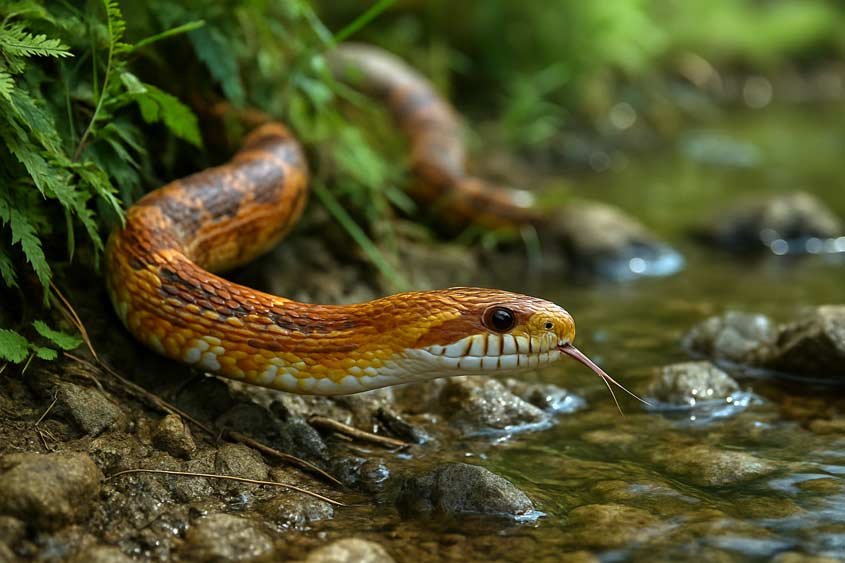
Meet the Corn Snake
There’s a reason the corn snake is often the very first reptile someone brings home. They’ve got this quiet charm about them, the sort of reptile that doesn’t shout for attention but wins you over anyway. If you’ve ever seen one coiled lazily under a bit of cork bark, scales catching the light in shades of orange and red like autumn leaves, you know exactly what I mean. Corn snakes are the easygoing companions of the reptile world—colorful, manageable, and, dare I say it, almost friendly in their demeanor.
| REPTILE PROFILE | |
|---|---|
| Reptile | Corn Snake |
| Binomial Name | Pantherophis guttatus |
| SCIENTIFIC CLASSIFICATION | |
| Kingdom | Animalia |
| Phylum | Chordata |
| Class | Reptilia |
| Order | Squamata |
| Family | Colubridae |
| Subfamily | Colubrinae |
| Genus | Pantherophis |
| Species | P. guttatus |
| Varieties | Numerous color morphs bred in captivity (e.g., albino, snow, amelanistic) |
| ENVIRONMENT | |
| Living Environment | Terrestrial; forests, grasslands, farmlands, and rocky outcrops |
| Found in | Southeastern and central United States |
| Space Requirement | Minimum 40-gallon enclosure for an adult (36–48 inches long) |
| Average Lifespan | 10–15 years in captivity |
| Exceptional Cases | Up to 20 years with excellent care |
| Length | 2–6 feet (60–180 cm) |
| Weight | 500–900 grams on average |
| Temperature | Ambient 75–82 °F (24–28 °C); basking spot 85–88 °F (29–31 °C) |
| pH | N/A |
| PERSONALITY | |
| Temperament | Docile, calm, and tolerant of handling |
| Social Behaviour | Solitary; only interacts with others during breeding |
| Diet | Carnivore |
| Food Type | Primarily rodents (mice and rats), occasionally small birds; fed pre-killed or frozen-thawed |
| KEY FACTORS AFFECTING LIFESPAN | |
| Enclosure / Tank size | Too-small enclosures restrict exercise and increase stress; secure lids required to prevent escape |
| Habitat / Water quality | Requires clean, dry substrate and fresh water; moderate humidity (40–60%) |
| Diet | Improper diet (overfeeding or underfeeding) can lead to obesity or malnutrition |
| Companions | Best housed alone; risk of stress, injury, or cannibalism if cohabited |
| Temperature / Environment stability | Needs stable temperature gradient; improper heating can cause illness or refusal to eat |
| CARE DIFFICULTY | |
| Difficulty Level | Easy to Moderate |
| Messiness | Low; produces manageable waste that requires regular but not excessive cleaning |
| Additional Requirements | – Secure enclosure with hiding spots – Heat source with temperature gradient – Clean water bowl for drinking and soaking – Appropriate substrate (aspen, cypress mulch, or paper-based) |
| Special Notes | Excellent beginner snake due to docile nature and ease of care; regular handling helps maintain tameness; ensure enclosure is escape-proof. |
Now, don’t get me wrong. A snake is never going to wag its tail when you walk into the room, but there’s something about a corn snake that feels approachable, even welcoming. They don’t come with that nervous, defensive streak you sometimes see in other snakes. Instead, they seem to tolerate (and in some cases, even appear curious about) being handled. That’s part of why they’ve gained such a reputation as the perfect beginner’s snake—but even seasoned keepers love them, and not just out of nostalgia.
Table of Contents
The name “corn snake” itself has a bit of history attached. No, they don’t eat corn. It comes from their old habit of hanging around grain stores, where mice and rats gathered for an easy meal. Farmers would find these slim, beautifully patterned snakes lurking among the corn cribs, and the name stuck. It’s a good reminder of how tightly woven snakes are into human history, even if we don’t always give them credit.
What I find fascinating is how corn snakes manage to walk that line (well, slither that line) between being hardy and forgiving, but also endlessly fascinating. Some reptiles you keep once you’ve gained the experience—say, a reticulated python or a water monitor—and they demand a certain level of commitment and respect. Corn snakes? They’re forgiving of mistakes. Forget to mist one day? They’ll cope. Temperature dips a little at night? They’ll shrug it off. That resilience makes them accessible, but it doesn’t make them boring. Quite the opposite.
If you’ve ever gone down the rabbit hole of corn snake “morphs,” you’ll know what I’m talking about. Over the decades, breeders have coaxed out an incredible variety of colors and patterns—snakes that look like they’ve been painted by hand, in everything from snowy whites to deep blood reds, even lavender and caramel shades. But even the wild-type corn snake, with its rusty red saddles and black-bordered blotches, has a classic beauty that’s hard to beat. It’s like comparing a vintage car to a flashy custom paint job; the original holds its own.
But it isn’t just looks. The corn snake’s temperament is where they really shine. You’ll often hear keepers say they’re “docile” or “gentle,” but let me put it in plain terms: they don’t freak out easily. That’s not something you can say about all snakes. Plenty of species, even smaller ones, are quick to strike or coil defensively if you move wrong. Corn snakes, by contrast, seem to take life as it comes. Pick them up carefully, support their body, and they’ll usually just weave through your fingers, tongue flicking, exploring like a slow-moving ribbon. It’s a kind of calm energy that makes them both beginner-friendly and enjoyable for someone who’s been keeping snakes for decades.
I’ll admit—my own first corn snake taught me more about reptile keeping than any care book ever could. She wasn’t perfect, and neither was I. I fumbled with humidity levels, I misjudged cage décor, I probably annoyed her more than once with my clumsy handling. But she was patient, in her own snake-ish way. And that’s the thing: corn snakes forgive your mistakes while you learn. A boa constrictor? Not so much. A delicate chameleon? Definitely not. But a corn snake? They give you room to grow.
It’s worth pointing out, too, that corn snakes aren’t flashy in terms of size. They don’t end up as unmanageable giants like Burmese pythons, nor do they stay so tiny that you’re always worried about breaking them. They settle into this perfect middle ground—three to five feet on average, slender but not fragile, big enough to be impressive when stretched across your arm, small enough to be housed comfortably in a standard enclosure. That balance, again, makes them ideal for keepers at all levels.
And maybe that’s the secret to their popularity: balance. They’re striking without being intimidating, manageable without being boring, hardy without being bland. They’re the kind of reptile that makes you want to keep learning, keep exploring. For many people, corn snakes are the gateway to the reptile world. But for others, they’re a lifelong favorite.
When I talk to new keepers, I sometimes compare choosing your first snake to choosing your first car. You wouldn’t hand a teenager the keys to a Ferrari, right? You start with something reliable, forgiving, something that teaches you the ropes without punishing every mistake. Corn snakes are the Hondas of the reptile world: dependable, versatile, but still fun to drive. And once you’ve “driven” one, you might never want to upgrade.
So here’s the deal: if you’ve ever thought about keeping a snake—if you’ve lingered in front of the reptile tanks at a pet shop, or watched videos of someone gently handling a brightly colored serpent—you owe it to yourself to look closer at the corn snake. They might not have the glamour of a rare python or the mystique of a venomous species, but they make up for it with personality, resilience, and sheer beauty. They’re the everyman’s snake, but also the connoisseur’s choice.
And that’s exactly why, in my mind, the corn snake isn’t just a good beginner pet—it’s one of the greatest ambassadors reptiles could ever hope for.
The Beauty of Corn Snake Colors and Patterns
If you’ve ever stood in front of a rack of corn snakes at a reptile expo, you know the feeling—it’s like staring at living jewels, each one more dazzling than the last. People talk about ball python morphs all the time (and fair enough, they’ve got plenty), but corn snakes? They’re the quiet heavyweights in the reptile beauty contest. Their natural form is already a masterpiece, but the range of morphs and patterns that breeders have brought out over the years is nothing short of astonishing.
Natural Variations
Let’s start with the wild type, the “original model.” Picture a snake with deep orange or rusty red blotches, outlined in black, running down a background of tan or gray. Flip them over, and you’ll see that iconic checkerboard belly—black and white squares that look like a picnic cloth. That belly alone is enough to set them apart from most other North American colubrids. It’s distinctive, almost playful, as if the snake itself was designed to be memorable.
What’s fascinating is that even within natural populations, you’ll see variation. Some wild corn snakes lean more toward reddish tones, while others look almost brownish or copper. If you’ve ever spotted one in its natural habitat, blending in with fallen leaves or hiding along a barn wall, you get a sense of just how well nature painted them to fit their world.
Morphs and Selective Breeding
Now here’s where the hobby gets wild. Over the last few decades, corn snake breeders have tapped into genetic quirks that produce a kaleidoscope of color morphs. It started small—an albino here, an anerythristic (black-and-white) snake there. But once people realized the potential, the combinations exploded.
There are snows, which are a blend of albino and anerythristic, turning the snake into a soft, frosty swirl of whites and pinks. Bloodreds, deep and almost glowing, like hot coals. Caramels, with golden-brown saddles that look like warm toffee. Then there are the lavenders—subtle, smoky, purple-gray tones that don’t even look real until you’re holding one.
And if you want patterns, corn snakes deliver. Striped morphs, motley morphs, tessera morphs—they all twist the typical blotched look into something new. A striped corn looks like someone ran a paintbrush down its back, a clean line from head to tail. Motley corns lose that belly checkerboard, replacing it with a cleaner underside. Tessera morphs have these crisp, thin lateral stripes that make the snake look sleek, almost futuristic.
The combinations are nearly endless. Breeders mix and match morphs like artists blending colors on a palette. Want a snow tessera? No problem. How about a caramel motley? Yep. It’s not unusual to see corn snake morph lists that run dozens of names long, each one describing some subtle genetic twist.
Why Keepers Are Drawn to Their Appearance
So why all the obsession with color? Well, let’s be honest: people are visual creatures. When you’re picking out a pet snake, especially if it’s your first, the look is a big part of the appeal. And corn snakes give you options without the price tag that usually comes with exotic morphs in other species. You can pick up a stunning morph for a fraction of what a rare ball python morph might cost, and you still get that hardy, easygoing temperament that corn snakes are known for.
There’s also something deeply satisfying about the contrast between their calm nature and their bright, flashy looks. It’s almost like having a sports car that drives like a reliable family sedan—eye-catching but manageable. When people walk into a room and see a corn snake stretched across a branch, those colors immediately spark conversation. Even folks who normally shrink back from snakes will pause and admit, “Okay, that one’s actually kind of pretty.”
I remember the first time I saw a snow corn in person. It was at a reptile show, coiled in a simple plastic tub. Under the fluorescent lights, its scales shimmered like pearl, and its eyes were this soft, translucent pink. I must have stood there for ten minutes, completely transfixed. I wasn’t even planning on buying a snake that day, but I left the show with that little snow corn in a box under my arm. And honestly? No regrets.
The Personal Side of Snake Aesthetics
Here’s the thing that often gets overlooked: color and pattern aren’t just about vanity. For keepers, these variations become part of the bond with the animal. That caramel corn snake you raised from a hatchling? Its particular shade and pattern become as familiar to you as a friend’s face. When it sheds, and those colors brighten up, it’s like rediscovering the snake all over again.
And unlike other reptiles that rely heavily on morph markets to stay interesting, corn snakes don’t need morphs to be compelling. Their base design is already perfect for survival—camouflage in leaf litter, striking enough to warn off predators, unique enough that humans remembered them well enough to give them a lasting name. The morphs are just icing on the cake, a way for us to explore the spectrum of what’s possible when genetics get creative.
The Collector’s Mindset
Of course, once you dive into corn snake colors, it’s hard to stop at just one. That’s another reason they’re so beloved. A person might start with a single wild-type, but soon they’re browsing breeder sites late at night, wondering if their collection needs a ghost corn or an okeetee. Spoiler: it does. Before long, you’re not just a keeper—you’re a collector, curating your own little gallery of living art.
And unlike species where keeping multiples quickly becomes impractical, corn snakes make it feasible. They don’t demand enormous enclosures, they don’t eat anything exotic (frozen-thawed mice are easy enough), and they generally don’t stress too much in captivity. So for the keeper who loves variety, corn snakes are like potato chips—you can’t have just one.
Corn snakes might be small compared to the giants of the reptile world, but when it comes to colors and patterns, they punch way above their weight. They embody the beauty of nature and the creativity of selective breeding, offering a rainbow of choices that never seem to run out. And whether you prefer the timeless look of a wild-type or the surreal palette of a designer morph, one thing’s certain: there’s a corn snake out there that’ll catch your eye and hold it.
Housing and Habitat: Creating the Perfect Home
If there’s one thing I’ve learned after years of keeping reptiles, it’s this: the enclosure isn’t just a box you keep the animal in—it is their world. For a corn snake, a well-set-up habitat makes the difference between a stressed, finicky feeder and a confident, thriving serpent that feels at home. And the beauty of corn snakes is that their housing needs strike that sweet spot: not as demanding as tropical lizards, not as barebones as hardy colubrids you see in the wild. You get to build them a cozy little ecosystem that’s both functional and, if you want, downright beautiful to look at.
Enclosure Size and Setup
Let’s tackle the big question first: how big should the enclosure be? There’s this ongoing debate among keepers—do you give a snake the largest space possible, or do you stick to the “enough to stretch out” rule? With corn snakes, you’ll hear both camps. Personally, I lean toward giving them room. A hatchling can start in something as small as a 10-gallon tank or a shoebox-sized tub if you’re running a rack system, but as they grow, they deserve the upgrade.
For an adult, a 40-gallon breeder tank is often considered the gold standard—plenty of length, enough floor space, and not so tall that the snake feels exposed. Some keepers go bigger, and I’ll be honest, watching a corn snake explore a four-foot-long enclosure is worth every bit of the extra effort. They’re active, curious snakes, and while they won’t complain in a smaller setup, you’ll see more of their natural behaviors when they’ve got some room to roam.
Temperature and Humidity Control
Now, let’s talk about climate. Corn snakes are native to the southeastern United States—think warm, temperate forests, fields, and barns. They’re not rainforest snakes, so you don’t need to crank humidity to tropical levels. Instead, aim for a gradient:
- Warm side: 85°F or so, provided by an under-tank heater or heat mat with a thermostat.
- Cool side: around 75°F, so they can thermoregulate.
- Nighttime drops: perfectly fine. Corn snakes tolerate a bit of cooling at night, just like they would in the wild.
Humidity should sit around 40–60%. That’s the sweet spot where their skin stays supple and shedding goes smoothly. Too dry, and you’ll get stuck sheds; too wet, and you risk respiratory issues. A simple water dish and the occasional mist during shed cycles usually does the trick.
Substrate and Decorations
This is where you get to play. Substrate choices range from the practical to the aesthetic:
- Aspen shavings are the classic go-to—clean, affordable, easy to burrow in.
- Coconut husk or eco-earth works if you want a more naturalistic look.
- Newspaper or paper towels? Not glamorous, but hey, they’re cheap and hygienic.
I’ll admit, I’m partial to substrates that let the snake burrow. Corn snakes love to tunnel, and watching them disappear into the bedding only to pop out somewhere else is half the fun. If you’ve only ever kept reptiles that sit on branches all day, seeing a snake make use of every inch of its enclosure—above and below—is pretty rewarding.
Decorations aren’t just for you—they’re for the snake. At a minimum, you’ll want:
- Two hides (one on the warm side, one on the cool side) so the snake feels secure no matter where it’s thermoregulating.
- A sturdy water dish (bonus points if it’s large enough for the snake to soak in).
- Some climbing branches or ledges—yes, corn snakes climb! They’re not strictly arboreal, but they’ll take advantage of vertical space if you give it.
- Fake plants or natural décor to break up sightlines. Snakes appreciate cover, even if it’s just a plastic vine draped across the tank.
Habitat Must-Haves
- Escape-proof enclosure (corns are notorious escape artists)
- Heat source regulated by a thermostat
- Two hides (warm and cool)
- Substrate that allows burrowing
- Water dish large enough for soaking
- Enrichment décor: branches, plants, rocks
The Art of Escape-Proofing
I can’t emphasize this enough: corn snakes are Houdinis. If there’s a gap, they’ll find it. I once underestimated a loose screen lid on a tank, and sure enough, woke up to find my snake gone. Hours of panicked searching later, I found her curled up inside a shoe in my closet. Lesson learned. Lock your enclosures, weight your lids, double-check everything. It’s not about paranoia—it’s about respecting their nature. A snake’s instinct is to explore, and if the only barrier is a flimsy lid, they’ll take the opportunity.
Going Naturalistic
Some keepers stop at the basics, but others lean into the naturalistic or bioactive setups. Imagine a terrarium with live plants, springtails, isopods, and a layered substrate that creates a mini-ecosystem. Corn snakes thrive in those environments, too, as long as you keep the balance right. The bioactive route takes more maintenance upfront but less over time, and it transforms the enclosure into something you’d be proud to display in your living room.
I had a friend who went full naturalistic with his corn snake enclosure: live pothos vines climbing across branches, a background textured to look like bark, even a little moss patch under the water dish. That snake didn’t just survive—it thrived. It hunted, explored, and interacted with the environment in ways you just don’t see in sterile setups. It reminded me that, at the end of the day, these animals are more than just pets—they’re wild at heart, and they deserve a slice of that world.
Setting up a corn snake habitat isn’t just about checking boxes—it’s about creating a balance between practicality and beauty. You can make it as minimal or as elaborate as you want, but the key is making sure the snake feels safe, has options, and can live out its natural behaviors. And honestly? That’s the most rewarding part of reptile keeping. Watching your animal interact with the space you’ve created for it—it feels almost like building a stage and then seeing the actor take it over, making it their own.
Feeding and Nutrition: What Corn Snakes Eat
One of the biggest worries new snake keepers have is feeding. You wouldn’t believe how many times I’ve heard the question: “But what do they actually eat?” People half expect me to say something exotic, like tropical birds or lizards caught in the wild. The truth is both simpler and, honestly, more convenient: corn snakes are rodent eaters through and through. And compared to some reptiles with finicky diets or live-prey requirements, corn snakes are refreshingly straightforward at the dinner table.
Diet in the Wild vs. Captivity
Let’s start with what nature intended. In the wild, corn snakes are opportunistic hunters. Their menu includes:
- Small rodents (mice and rats being the mainstay)
- Young birds or eggs if they can snag them
- The occasional lizard or frog, depending on availability
They’re constrictors, which means they grab their prey, coil around it, and suffocate it before swallowing. It’s an efficient, no-nonsense strategy, and it’s worked for millions of years.
In captivity, though, we simplify things. We don’t want our snakes hunting in risky conditions, and we don’t want to deal with parasites that come from feeding wild prey. So the captive diet boils down to frozen-thawed rodents—mice for most corn snakes, rats for the larger adults. It’s clean, reliable, and easily accessible from reptile shops or online suppliers.
Feeding Schedule for Hatchlings and Adults
This is where keepers sometimes overthink things. Corn snakes don’t need daily meals. They’re not like a dog or a cat sitting by the bowl each morning. Instead, they thrive on a slower rhythm that matches their metabolism.
- Hatchlings (under 6 months): one pinky mouse every 5–7 days
- Juveniles (6 months to 1 year): gradually move up to fuzzies or hoppers, every 7–10 days
- Sub-adults (1–2 years): small adult mice, about every 10–14 days
- Adults (2+ years): one medium or large mouse—or a small rat—every 2–3 weeks
That’s it. No complicated formulas, no special supplements or gut-loading like you’d need with insectivorous reptiles. Corn snakes are marvels of simplicity in the feeding department.
Tips for Healthy Feeding Practices
Now, just because it’s simple doesn’t mean you can phone it in. There are little nuances that make feeding smoother and healthier for your snake.
- Always thaw properly. Take the rodent out of the freezer, thaw it in the fridge, then warm it to room temperature (or a little warmer) before offering. A cold meal can be rejected.
- Use feeding tongs. Wiggling the mouse slightly with tongs mimics prey movement and keeps your fingers safe.
- Feed outside the enclosure if you like, though it’s not a requirement. Some keepers swear by separate feeding tubs to avoid “cage aggression,” but corn snakes are usually gentle enough that it’s not an issue.
- Don’t handle right after feeding. Give them at least 48 hours. Nothing ruins your evening like a regurgitated mouse on the carpet.
And here’s a tip that comes from hard experience: don’t panic if your corn snake refuses a meal now and then. They’re not machines. Sometimes they’re in shed, sometimes the temperature’s off, sometimes they’re just not hungry. Healthy adults can go weeks without eating and be fine. It’s only if the refusals become consistent, or if the snake loses noticeable weight, that you need to dig deeper into the cause.
Frozen-Thawed vs. Live
This is a topic that sparks heated debates in reptile forums. Some people insist on feeding live prey because “it’s more natural.” And yes, in the wild, corn snakes do take live animals. But here’s the thing: in captivity, frozen-thawed is safer. Live mice can and will fight back—biting, scratching, even injuring or killing a snake that doesn’t strike properly. I’ve seen the aftermath, and it’s not pretty.
Frozen-thawed eliminates that risk, and most corn snakes transition to it easily. If you get a stubborn hatchling that only wants live, patience and persistence usually win. Wiggle the thawed prey, scent it with a bit of lizard or bird down, or try feeding at night. Nine times out of ten, they’ll come around.
Anecdotes From the Feeding Trenches
I’ll never forget my first time feeding a hatchling corn. I thawed the tiniest pinky mouse, put it on tongs, and hovered it nervously in front of the snake. Nothing. He just flicked his tongue, unimpressed. My heart sank—I thought I’d done everything wrong. Then, without warning, he struck like a coiled spring, grabbed that mouse, and coiled it up in what I can only describe as the fiercest hug I’ve ever seen from something no longer than a pencil. That’s the moment I realized: feeding time isn’t just a chore, it’s a glimpse into their wild instincts.
On the flip side, I once had an adult that refused food for two months straight during the winter. I nearly drove myself crazy trying to tempt him—different mice, different times of day, even scenting tricks. Finally, I just relaxed and waited. One day, like nothing had happened, he accepted a large mouse and never missed a meal again. Sometimes, you have to learn patience. The snake knows its own body better than you do.
Common Feeding Mistakes
If I had to boil it down, the three big mistakes new keepers make with corn snake feeding are:
- Overfeeding. Corn snakes are masters of looking hungry, but too many large meals lead to obesity.
- Feeding prey that’s too large. The general rule is: prey should be about 1.5 times the snake’s girth at the widest point.
- Panicking over skipped meals. As mentioned, it’s normal for corn snakes to fast occasionally.
The Joy of Simplicity
At the end of the day, feeding a corn snake is easy compared to many other reptiles. You don’t need a cricket colony, you don’t need to dust every meal with calcium powder, you don’t need to chase live prey around the enclosure. You just need a freezer stash of mice and a little routine. And if you ask me, that’s part of their enduring appeal.
Corn snakes give you the chance to witness a predator’s natural behavior—the strike, the coil, the swallow—without the stress and unpredictability of live hunting. It’s primal, it’s fascinating, and it’s all wrapped up in a pet that otherwise spends its days calmly cruising its enclosure or curled up under a hide.
Corn snakes eat simply, but the act of feeding them connects you to something ancient. You’re watching the same survival strategy that’s played out for countless generations in the wild. And somehow, in your living room, with a thawed mouse and a pair of tongs, you get to be part of that story.
Breeding Corn Snakes: Patience, Timing, and Care
For a lot of keepers, breeding corn snakes isn’t just about producing hatchlings—it’s about experiencing one of the most fascinating natural cycles in reptile keeping. Watching a female coil protectively around her eggs, or seeing that first tiny nose poke out of a shell, it’s something you never forget. But let’s be real, it’s not as simple as tossing a male and female together and waiting. There’s timing, conditioning, and patience involved.
Preparing Adults for Breeding
The first thing to know: you shouldn’t even think about breeding unless your corn snakes are healthy, well-fed, and mature. Females especially need to be at least three years old and strong enough to handle the energy demands of laying a clutch. A thin, underfed female can become egg-bound, which is as dangerous as it sounds. Males can breed a little earlier, around two years, but size and condition matter more than age.
- Female size benchmark: At least 300–400 grams, with good muscle tone
- Male size benchmark: Healthy and eating consistently, though they can be smaller than females
- Diet boost: Offer prey more regularly before the breeding season to build strength
I remember a keeper once bragged about breeding a young female barely two years old. She laid, yes, but the eggs were mostly infertile and the snake took months to recover. A good reminder that shortcuts don’t pay off.
Cooling and Pairing
Corn snakes in the wild naturally slow down in cooler weather, and breeders often mimic this by providing a “cooling period” or brumation. Dropping temps into the mid-60s Fahrenheit for 8–10 weeks helps reset their breeding cycles. Some hobbyists skip this step, but many swear it improves fertility rates.
After warming them back up, you can introduce the male to the female’s enclosure. Don’t just toss him in and leave; observe. Courtship isn’t dramatic—it’s often subtle nudging, gentle coiling, and then, if the female’s receptive, mating. If she’s not, she’ll push him away or simply move off.
- Signs of receptivity: Female staying still, lifting her tail slightly
- Signs of refusal: Aggression, fleeing, or complete disinterest
Egg Laying and Incubation
A successful pairing means you’ll soon notice a plump, swelling female. About four to six weeks later, she’ll lay a clutch, often between 10 and 30 eggs. Here’s where you need to give her a proper laying box: a container filled with damp sphagnum moss or vermiculite, something that feels private and safe. Without it, she might scatter eggs around the cage, drying them out.
Once laid, carefully transfer the eggs to an incubator set around 82–84°F. Humidity is crucial—too dry and the eggs collapse, too wet and they drown. Most hatch within 55–65 days.
Raising Hatchlings
Hatchlings are impossibly tiny, no thicker than a pencil, but they’ve got all the personality of their parents. Don’t rush to feed them right away. Wait for their first shed, usually within a week. Then, offer pinkie mice. Some take to food immediately, others need a little coaxing—like scenting with a lizard or frog, which mimics their natural prey.
Here’s the part few people tell you: raising dozens of hatchlings is a lot of work. Each needs its own enclosure, fresh water, regular feeding, and careful records. It’s rewarding, yes, but also a commitment.
Something is humbling about breeding corn snakes. You realize how much of the process isn’t really in your control—nature runs the show, you’re just helping it along. And when those eggs finally hatch, and the tiny heads push through, it feels like witnessing a small miracle.
Why the Corn Snake Stands Out
When you step back and look at the bigger picture, the corn snake does live up to its reputation. It’s colorful, yes, but not just in the literal sense of its patterns and morphs—it’s colorful in personality too. There’s a calm, steady confidence in these snakes that makes them such good companions for both the beginner and the seasoned reptile keeper. You don’t need to wrestle with aggression, worry constantly about size, or deal with impossible care demands. Instead, you get a snake that’s manageable, fascinating, and surprisingly personable if you give it the chance.
I’ve kept plenty of reptiles in my lifetime—some that were a dream, some that were… let’s just say “challenging.” But my corn snakes? They’ve always been the ones I recommend to friends dipping their toes into the world of snakes. They won’t bite the hand that feeds them (literally, unless you smell like a mouse), they don’t outgrow your tank overnight, and they live long enough that you can truly build a rhythm with them. A decade or two with the same animal—it’s not just a pet, it becomes part of your story.
And isn’t that the point of this hobby? Sure, it starts with the fascination—the shimmer of scales, the intrigue of a predator moving silently in your hands. But what keeps you hooked is the relationship, that quiet bond you share with an animal that most people misunderstand or even fear. With corn snakes, you don’t just keep them; you learn from them, you admire them, and in some ways, you even change alongside them.
So whether you’re just getting started, or you’ve already got a room full of enclosures humming with heat lamps and the earthy smell of reptile substrate, the corn snake deserves a spot on your list. It’s proof that sometimes the simplest choice is also the best.
After all, flashy isn’t always better. Harder isn’t always more rewarding. Sometimes, the snake that just hangs out calmly in your hands, flicks its tongue a couple of times, and quietly explores the world—that’s the one that wins you over for life.
Best Seller Products On Amazon*